

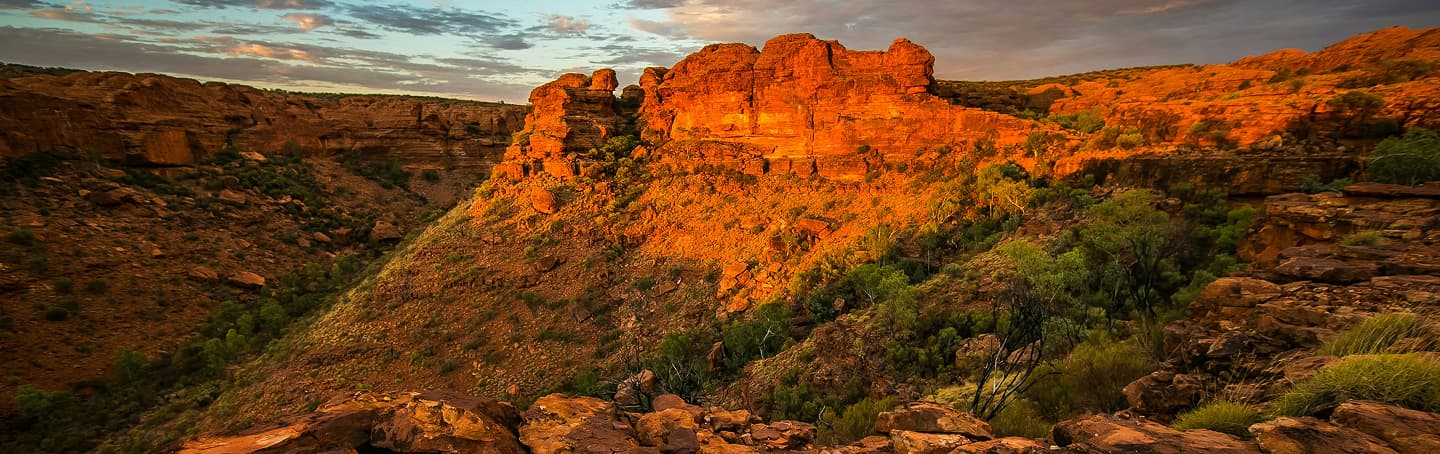

Rangelands Region

The Rangelands of Western Australia covers approximately 220 million hectares (approximately 87% of Western Australia) and extends north and east from the south- west agriculture precinct.
Within the Rangelands of Western Australia are the major regional towns of Carnarvon, Broome, Derby, Kununurra and Kalgoorlie-Boulder. These areas are covered by the Midwest, Pilbara, Kimberley, Goldfield-Esperance and Gascoyne Development Commissions. There is a diverse array of industries across the region including pastoralism, tourism, horticultural, mining, indigenous land and conservation.
The Rangelands of Western Australia is classified into 20 IBRA bioregions (Interim Biogeographic Regionalisation of Australia). IBRA bioregions are geographically distinct regions based on common climate, geology, landform, native vegetation and species information. There is a total of 89 IBRA bioregions across Australia.
From a Landcare/Grower Group perspective, the Rangelands of WA is classified into five regions being Kimberley, Pilbara, Gascoyne, Murchison, Goldfields/Nullarbor and Desert with each varying greatly from one another. The regions of Gascoyne, Murchison and Goldfields/Nullarbor combine to what is known as the Southern Rangelands, with the Pilbara and Kimberley regions known as the Northern rangelands.
Of the 220 million hectares of rangelands, 857,833 km2 is designated to the pastoral sector comprising of 435 stations which are owned by individual or families, companies, aboriginal corporations, mining companies and publicly or foreign owned.
Gascoyne
Gascoyne region, covering 135,277 km2 includes the Shires of Carnarvon, Shark Bay, Exmouth and Upper Gascoyne, with Carnarvon acting as the regional centre. Other major towns in the Gascoyne include Exmouth, Coral Bay, Denham, Monkey Mia, Gascoyne Junction and Burringurrah.
The population for the Gascoyne is approximately 10,324 with 12% of those identifying themselves as Torres Strait Islander or Aboriginal. The main industries found in this region are mining, agriculture and tourism. The Gascoyne region is home to 67 active pastoral leases which cover approximately 75% of the area.
The Gascoyne region is dominated by the Mulga shrubland with spinifex and Eremophila understoreys. The region also has chenopod communities with a variety of saltbush and bluebush species. Eucalyptus is generally associated with watercourses. In recent years there has been a spread of Buffel grass which has been a valuable addition to the region providing a groundcover protecting the soil, whilst also providing a feed source for livestock, although not as nutrient rich as many of the native perennial grasses.
The Gascoyne River is the longest river in Western Australia, extending inland approximately 550 km, with the headwaters near the Three River Station homestead and the mouth of the river at Carnarvon. Major floods have occurred in 1960, 1980, 1995, 2000, 2010 and 2021 as the result of the large catchment receiving heavy rains. The townsite is protected from flood due to the installation of massive levy banks, although these don’t stop some of the horticultural areas from flooding after heavy rainfall events in the catchment.
The Gascoyne River is extremely important for the Shire of Carnarvon as its delta is home to a very rich and prosperous horticultural district. The 1500 hectares of fertile soils with a sub-tropical climate, minimal pests and diseases and secure water resource allow the cultivation of a wide variety of fruit and vegetables including bananas, table grapes, capsicum, mangoes, melons and tomatoes. The Gascoyne River provides the water for the district. Whilst the river is flowing it is directly pumped out of. When there is no flow, bores pump out of the aquifers which have been recharged during flow periods. Generally, water is not an issue but still needs to be managed carefully.
The Gascoyne is home to the World Heritage Areas of Ningaloo and Shark Bay, and several national parks including Dirk Hartog Island National Park, Cape Range National Park, Francois Peron National Park and Kennedy Range National Park,
The Ningaloo Coast World Heritage Area
Covers an area of 604,500 hectares and more than 300 km of coastline. It is one of the longest ear shore reefs in the world. Where the rugged arid landscape of Cape Range and the clear turquoise waters of the Ningaloo Reef meet.
https://www.dbca.wa.gov.au/management/world-heritage-areas/ningaloo-coast-world-heritage-area
Shark Bay World Heritage Area
Best known for is population of dugongs, vast seas grass beds, stromatolites it is a rich, colourful and diverse landscape, covering approximately 2.2 million hectares and a coastline stretching 1500 km.
https://www.dbca.wa.gov.au/management/world-heritage-areas/shark-bay-world-heritage-area
Kennedy Range National Park
Dominated by a vast sandstone plateau, between 12 km and 25 km wide and 75 km long. And 80 m above the surrounding red earth plain.
https://exploreparks.dbca.wa.gov.au/park/kennedy-range-national-park
Murchison
The Murchison region (128,620 km2) includes the Shires of Murchison, Meekatharra, Cue, Mount Magnet, Sandstone and Yalgoo. It is named after the Murchison River (Sir Roderick Murchison – geologist) that flows through it with it ending at the coastal town of Kalbarri.
The Murchison regions climate is classified as arid, with an average annual rainfall of approximately 200-250 mm, although amounts vary significantly from year to year. Predominantly it is winter rainfall but can get summer rains from cyclones and thunderstorms. Summers are hot and dry with cool winters.
The Murchison landscape is dominated by mulga (Acacia aneura) shrublands. Other plant communities across the region include saltbush (Atriplex spp.) on calcareous soils, samphire (Tecticornia spp.) on saline areas and areas of perennial grasses and Eremophila spp. Common across the area and also a valuable stock feed is cotton bush (Ptilotus obovatus). Eucalyptus trees are generally only found around watercourses.
The Murchison River is the second longest in Western Australia, with a catchment of approximately 82,000 km2. It has its headwaters in the Meekatharra region, where it travels across dry plains, hills, salt lakes and gorges before finishing in the Indian Ocean at Kalbarri. The two major tributaries of the Murchison River are the Sandford and the Roderick, which like the Murchison only flow during significant rainfall events, although there are many permanent pools along the river. The Wooleen Lake is an important wetland, receiving water maybe every four years, filling every 10 and overflowing every 30 years. It was formed when a fault about 60,000 years ago cut the Roderick River from the Murchison River.

Goldfield Nullarbor
The Goldfield-Nullarbor region includes the City of Kalgoorlie-Boulder and the shires of Coolgardie, Dundas, Laverton, Leonora, Menzies and Wiluna. It is approximately 235,850 km2 with 109 pastoral properties with tenures including pastoral leases, mining leases, unallocated crown land (UCL), DBCA managed land/reserves and indigenous owed pastoral leases.
This region experiences a semi-arid to arid climate with hot summers and mild winters. Summer days can be extremely hot, with winter nights getting to below freezing. Rainfall is about 150-250 mm which falls across the year, but there are large variations year to year.
The Goldfields is characterized by granite rocky outcrops, open plains, mulga shrublands, eucalyptus woodlands, freshwater lakes and salt lakes.
The Nullarbor is dominated by broad, gently undulating limestones plains with vegetation predominantly chenopod (saltbush and bluebush) species with an overstory of Mulga shrubland in some areas. In the northern and western areas, the plains are progressively more wooded. Where fire has removed chenopod communities, perennial grasses are common. The coastal fringe of the Nullarbor contains marine dunes and limestone escarpments with vegetation a mix of mallee, eucalyptus and myall woodlands.
There are no major river systems or permanent watercourses in this region, with the watercourses only flowing when there has been a large rainfall event which is usually associated with a cyclonic event.
Desert
This region covers the arid inland of Western Australia including the Central Ranges, Gibson Desert, Great Sandy Desert, Great Victorian Desert and the Little Sandy Desert. These are also coincidently the IRBA bioregions for the area. Most of the region is Unallocated Crown Land (UCL), Aboriginal reserves or leases and conservations reserves.
The climate is hot, arid desert which is some of the driest parts on the continent. Rainfall is seasonal but tends to be winter dominate in the south and summer dominate in the north. Drainage in this area is either internal or no existent.
Great Sandy Desert is red sandplains, dune fields (large areas of sand dunes that are formed in inland basins) and remnant rocky outcrops, with vegetation generally spinifex grasslands, low woodlands and shrubs. The Central Ranges is dominated by red sandplains and rugged ranges, with spinifex grasslands with open Mulga woodlands. The Little Sandy Desert is dune fields with sandstone ranges, and vegetation dominated by steppe acacia and spinifex grasslands on the sandplains and river gum communities on alluvial deposits in and associated with the ranges. The Great Victora Desert bioregion is characterized by dune fields with playa lakes (ephemeral lakes) and lunettes (stationary crescent shaped dunes). The vegetation in this region is predominantly marble gum and mulga with an understory of spinifex grasslands. The Gibson Desert has vast undulating sandplains, dune fields and stony plains with mulga and other mixed shrubs with and understorey of spinifex grasslands.
Pilbara
The Pilbara region is one of the largest regions in the state and covers an area of 507 896 km2, of which 62 pastoral stations cover 13 million hectares. The region stretches from the Indian Ocean through to the Northern Territory border across the Great Sandy Desert.
The Shires of Ashburton, East Pilbara, Town of Port Hedland and City of Karratha are found in this region, with a residential population being approximately 59,894 and an additional 25,000 people estimated to work in the region at any one time. Of this, the Aboriginal population is approximately 14% of the total population.
The Pilbara climate is characterised by very hot summers, mild winters with low and variable rainfall. There is an average rainfall of 300-350 mm in the north-east which falls to less than 250 mm in the south and west. In general, there is more rainfall in summer and autumn, with much less during the winter and spring periods.
The environment of the region is dominated by grasslands in the north that transition into shrubland towards the south. This vegetation is fed by a network of permanent and ephemeral river systems which are driven by cyclonic and tropical depressions.
The Fortescue River is the third longest river in Western Australia stretching 760 km from the Ophthalmia Ranges to the coast, discharging into the sea southwest of Dampier. The area surrounding the river, boasts home to more than 500 plant species, 120 species of birds, 30 species of mammal and 150 species of reptiles. It is a popular spot for tourists for walking, fishing, canoeing, bird watching, wildflowers and camping. Deep Reach Pool, which is located along the river is important to the local Yindjibarndi people as the sacred home to the Warlu serpent.
The Ashburton River is another significant river for the region that stretches approximately 680 km from 100 km south of Newman and discharging at the original Onslow townsite. The Ashburton River is a popular site for camping, fishing and canoeing.
The Pilbara is home to some of the most spectacular landscapes, of which large suites have been protected by the State through the National Park System.
Karijini National Park
The stunning national park is the result of erosion over 2.5 billion years creating the stunning red landscape. The amazing gorges and breathtaking crystal blue natural pools leaves you feeling well and truly alive.
https://exploreparks.dbca.wa.gov.au/park/karijini-national-park
Millstream- Chichester National Park
This National Park is focussed on the Fortescue River which creates natural spring fed pools and creates an oasis in the desert. Surrounded by stunning cliffs, red plains, spinifex grass and termite mounds, visitors can view the pastoral history of Millstream Homestead, play in the water as well as enjoy the many hikes and drives as well as learn about the plants used by the Aboriginal people.
https://exploreparks.dbca.wa.gov.au/park/millstream-chichester-national-park
Murujuga National Park
Home to the most diverse and largest collection of rock art in the world with a diverse landscape including cliffs, narrow valleys, mangroves and mudflats in the Dampier Archipelago. This park is jointly managed by DBCA and Murujga Aboriginal Corporation (MAC).
https://exploreparks.dbca.wa.gov.au/park/murujuga-national-park
Community Groups you can join:
|
Group name |
Link |
|
Ashburton LCDC |
|
|
Cape Conservation Group Inc. |
|
| Care for Hedland Environmental Association | |
|
Central Desert Native Title Services |
|
|
Gascoyne Catchments Group |
|
|
Juluwarla Group Aboriginal Corporation |
|
| Pilbara Mesquite Management Committee | |
|
Pilbara Wildlife Carers Association Inc. |
|
|
Southern Rangelands Pastoral Alliance |
|
|
Yindjibarndi Aboriginal Corporation |
Biosecurity groups
|
Group name |
Link |
|
Carnarvon Rangelands Biosecurity Association |
|
|
Goldfield Nullarbor Rangelands Biosecurity Association |
|
|
Meekatharra Rangelands Biosecurity Association |
|
|
Pilbara Regional Biosecurity Group (PRBG) |
Rangelands NRM
The Rangelands NRM is the largest NRM region in the state stretching across 227 million hectares or 85% of Western Australia. It was established to address the need for greater ecological preservation and sustainability across the region. As with all regional NRM groups, this is achieved through the creation of relationships and partnerships across all members of the community, including governments (25 Local Governments), schools, universities and industry.
Within this vast landscape there are many environmental diamonds, of which four are UNESCO World Heritage listed, five RAMSAR sites.
Agriculture/ Land use
As the Rangelands are so expansive, the land use and industries are just as diverse. These include pastoralism, aquaculture and fishing, tourism, horticultural, mining, indigenous land and conservation.
The predominant industry are the pastoral industries, through extensive grazing on native vegetation, however it is the mining industry sector that dominates the economic forces of the region through the export of raw material.
Pilbara Tourism - Pilbara Country
